

The Impact of School Meals on Communities
September 2026
Families continue to need support for food
Many North Dakota families continue to struggle to afford the basics needed to live a healthy life, a struggle that will worsen as costs continue to rise. Unfortunately, the number of children in poverty jumped up in the most recent data, showing that 23,000 or 13 percent of children now live below poverty (or $33,000 for a family of four).1 Many families above poverty also struggle to make ends meet, with more than one in four North Dakota children living below 200 percent of poverty (or $66,000 for a family of four).1 In 2025, one in four children received food from Great Plains Food Bank; the same year, the food bank served over 167,000 people in North Dakota.2
Food security is complex and about more than simply having the resources to purchase food. Access to food and specifically access to the type of food that supports nutrition and culture, matters too. Tribal communities today experience higher food insecurity, which has been shaped by policy decisions across many generations that limited access to food, fertile land to grow and harvest traditional foods, and financial resources, and have made it harder to remain connected to their culture and build community.3 For example, two Tribal Nations within North Dakota lived and relied on land along the Missouri River. The fertile land provided resources for agriculture and economic security. When the federal government built dams along the Missouri River in the mid-20th century, Tribal Nations were forced to give up land that was rightfully theirs and relocate to land without the same access to natural resources.4 The loss of this land was significant for food security, particularly when paired with a lack of investment in the areas where Tribal Nations were relocated.

While data is not available for North Dakota, nationally, American Indian and Alaska Native people have food insecurity rates roughly double that of white people.4 Food prices in reservation communities are higher on average than national food prices. A study from 2018 found the cost of apples to be 31 percent higher in reservation communities, 45 percent higher for eggs, and 85 percent higher for bread.4
Nationally, Tribal communities have less access to larger grocery stores more likely to have fresh food options.5 For this reason, food resource programs that provide healthy food options where Tribal communities live, work, and attend school are critical, like the National School Lunch Program. Another federal program called the Food Distribution Program on Indian Reservations (FDPIR) provides a food package each month to eligible families living on a Tribal reservation, as an alternative to the Supplemental Nutrition Assistance Program (SNAP) which requires traveling to a grocery store.6 While SNAP does require travel to a grocery store, it also is a critical food resource program for families alongside the Special Supplemental Nutrition Program for Women, Infants, and Children (WIC) which offers food benefits for pregnant people and young children. Tribal communities across North Dakota benefit from all these food resource programs: 5,533 people participated in the FDPIR in June 2026, about 1 in 5 SNAP participants in North Dakota are American Indian, and WIC helps people across every county in the state.7,8,9

School meals are a critical safety net for families across the state
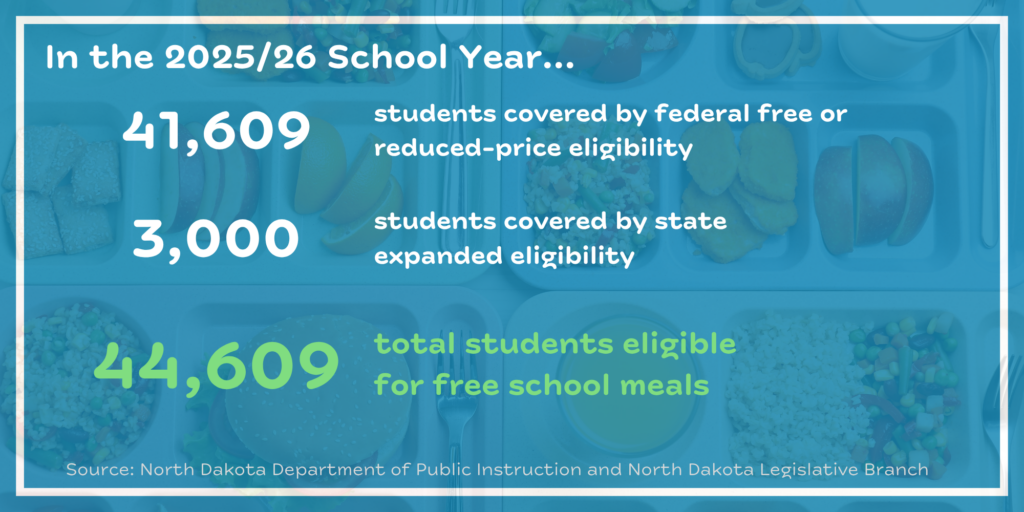
School meals and other summer food programs are an important source of healthy food for children of all incomes and serve as a critical safety net for families struggling across the state. The federal school lunch and breakfast program provides free or low-cost meals to families that qualify. North Dakota has invested $3 million per year in state funds over the last four years to cover reduced-cost meals and expand eligibility to even more children.10 Families up to 225 percent of the federal poverty level are now eligible to receive a free school meal, or about $74,000 for a family of four.11 In the 2025/26 school year, about 44,600 students were eligible for free school meals at public schools in North Dakota (41,609 qualified at the federal eligibility levels and 3,000 at the expanded eligibility covered fully by the state).12,13 Ongoing state investment will ensure a seamless continuation of the expanded eligibility for families.
A family typically qualifies for a free or low-cost meal by completing an application to determine their eligibility. Some schools use a different process though, called the Community Eligibility Provision (CEP).14 Schools use data that is already available to identify students eligible for federal food and benefit programs, like SNAP, Temporary Assistance for Needy Families (TANF), or the FDPIR, or are in the foster care system, experiencing homelessness, or living in a migrant family. A school is eligible if at least 25 percent of the school falls into one of these categories. From a family’s perspective, CEP schools do not require paperwork, but all students can eat a free breakfast or lunch. From a school perspective, meals are reimbursed using a federal formula. If at least 62.5 percent of the school falls into one of the CEP categories, all meals are reimbursed at the highest federal rate.15 In North Dakota, 48 schools are participating in the CEP to provide free meals to all students.16 Some schools may also take advantage of a federal flexibility in school meals called Provision 2. Using this flexibility, schools offer meals at no charge to students and only require applications from families every four years.17
When school is out for the summer, summer food programs help fill the gap for many families. The Summer Food Service Program provides nutritious meals to children in eligible communities. In July 2024, about 4,600 students received a free lunch each day provided by the Summer Food Service Program.18 Compared to the school year, this is only 15 percent of students who receive a free or reduced-price meal. While summer meals are critical for families that can access them, many other families face barriers to using this program. A different but complimentary summer food program, SUN Bucks or Summer EBT, provides a $120 grocery benefit for the summer to families eligible for free or reduced-price meals.19 More than 40,000 children will automatically receive Summer EBT benefits in 2026 without having to fill out any additional information. Some additional children may be eligible and can apply separately. This means $4.8 million in federal grocery benefits are going directly to support families, local grocery stores, and communities this summer.

School meals play a unique role in food security for Tribal communities
Food security is an economic and racial justice issue. Addressing food security in North Dakota means recognizing the historical injustices that shape the food and economic resources available to Tribal communities today and designing policies that ensure solutions work for Tribal communities and BIPOC families.
In North Dakota, 11,843 American Indian or Alaska Native students attend public schools, making up 10 percent of overall enrollment.20 In fact, American Indian or Alaska Native students live and attend school in every county across the state. All types of schools are eligible to participate in the federal school meal program and the state expansion to 225 percent of the poverty level. This means public and non-public schools, such as private schools or schools operated by the Bureau of Indian Education, can participate.21
In North Dakota, 27 schools are located within one of the American Indian reservations in North Dakota, and the majority offer free meals to all students, either through CEP (19 schools) or Provision 2 (four schools).21,22 Two alternative schools do not participate in the national school lunch program, but in the remaining two schools located within a reservation in North Dakota, families do complete an application to qualify for free or reduced-price meals. Eligibility at these two schools is about 58 percent of students.20 The state expansion of eligibility (to 225 percent of poverty) impacts these two schools but largely did not change the school meal landscape for other students attending schools in reservation communities. Expanded eligibility does greatly impact American Indian students attending schools where free meals are not already available to all students. Of the 6,366 American Indian students attending one of these schools, 65 percent qualified for free and reduced-price meals in the last school year.20 Expanded eligibility helps reach more of the American Indian youth not currently participating.
Expanding access to school meals supports racial equity and can help close the gap in economic and educational disparities among other children of color too. Previously passed policies systematically limited opportunities for families of color with effects lasting generations and have resulted in present-day disparities in poverty rates for BIPOC children. Expanded eligibility for free school meals helps reach more families historically left out of economic support policies. With expanded eligibility up to 225 percent of the federal poverty level, estimates show that 58 percent of American Indian children, 61 percent of Black children, and 41 percent of children identifying as Asian, Native Hawaiian, Other, or two or more races are now eligible for school meals.24
Continue and build upon current school meal programs
Continuing the current school meal programs, including expanded eligibility to 225 percent and Summer EBT, will allow a seamless continuation of benefits for families. This means a continued state investment to cover reduced-cost meals and the full cost for families above the federal eligibility level. North Dakota can build on progress made in recent years by offering healthy school meals for all students. Nine other states have permanent policies in place to provide school meals to all, and research shows when free meals are offered to all students, participation in the program increases and academic outcomes improve.25,26
Policymakers should consider ways to implement changes included in the federal “Tribal Nutrition Improvement Act of 2022” at the state level to further support Tribal communities directly, including categorical eligibility for free school meals for enrolled members of Tribal Nations and an increase in reimbursement rates for school meals served at schools on or near reservations.
Footnotes
- U.S. Census Bureau, “Age by Ratio of Income to Poverty Level in the Past 12 Months, 2020-2024 American Community Survey 5-Year Estimates, Table B17024.”
- Great Plains Food Bank, “Our Annual Report,” 2025.
- Maillacheruvu, S.U., “The Historical Determinants of Food Insecurity in Native Communities,” Center on Budget and Policy Priorities, Oct. 4, 2022.
- State Historical Society of North Dakota, “Lesson 1: Changing Landscapes, Topic 1: Garrison Dam and Diversion, Section 3: The Taking,” accessed July 27, 2026.
- Saksena, M., and Kaufman, P., “Native Americans Living in Tribal Areas Face Longer Trips to the Grocery Store,” U.S. Department of Agriculture, Economic Research Service, Apr. 6, 2015.
- U.S. Department of Agriculture, Food and Nutrition Administration, “FDPIR Factsheet,” accessed on Aug. 24, 2026.
- Anderson, M., Child Nutrition and Food Distribution Programs, “RE: FDPIR by Tribe?,” email to Xanna Burg, North Dakota KIDS COUNT, Aug. 24, 2026, on file with author.
- North Dakota Department of Health and Human Services, “Unduplicated Counts of Cases and Recipients by County of Physical Residence, State Fiscal Year 2023.”
- North Dakota KIDS COUNT, “Participants in the Supplemental Nutrition Program for Women, Infants, and Children (WIC) in North Dakota, 2025.”
- North Dakota KIDS COUNT, “2025 Legislative Session: Children’s Well-Being Bills,” June 2025.
- North Dakota Department of Public Instruction, “Child Nutrition and Food Distribution Programs Income Eligibility Guidelines, July 1, 2026 to June 30, 2027.”
- KIDS COUNT Data Center, “Eligible recipients of free or reduced-price lunch in North Dakota, 2025/26.”
- North Dakota Legislative Branch, “Interim Update – Compliance Report, Department of Public Instruction Budget No. 201,” accessed on July 27, 2026.
- U.S. Department of Agriculture, Food and Nutrition Administration, “Community Eligibility Provision,” accessed on July 27, 2026.
- U.S. Department of Agriculture, Food and Nutrition Administration, “Community Eligibility Provision Slider Tool,” accessed on July 27, 2026.
- North Dakota Department of Public Instruction, “2026 Community Eligibility Provision (CEP) Annual Notification of Schools,” accessed on July 27, 2026.
- U.S. Department of Agriculture, Food and Nutrition Service, “Provision 2 Guidance National School Lunch and School Breakfast Programs,” accessed on July 27, 2026.
- Food Research & Action Center, “Hunger Doesn’t Take a Vacation, The Reach of Summer Meals,” Mar. 2026.
- North Dakota Department of Public Instruction, “Food Programs, Summer EBT 2026,” accessed on July 27, 2026.
- North Dakota KIDS COUNT calculations using North Dakota Department of Public Instruction, “1-InclusiveEnrollment.xlsx,” KIDS COUNT information request, received on June 15, 2026, on file with author.
- Schloer, L, Child Nutrition and Food Distribution Programs, “RE: school meals and tribal communities,” email to Xanna Burg, North Dakota KIDS COUNT, Sep. 12, 2024, on file with author.
- North Dakota KIDS COUNT calculations using North Dakota Department of Public Instruction, “School Directory Contact Information, School Year 2025-2026, Nov. 25, 2025,” downloaded on July 30, 2026. Tribal reservations were identified using U.S. Census Bureau, “2023 TIGER/Line Shapefiles: American Indian Area Geography, American Indian/Alaska Native/Native Hawaiian Area,” downloaded on Sep. 11, 2024.
- U.S. Congress, “S.4625 – Tribal Nutrition Improvement Act of 2022,” accessed on Sep. 18, 2024.
- U.S. Census Bureau, American Community Survey, Analysis of Public Use Microdata Sample for 2020-2024.
- Food Research & Action Center, “Raise Your Hand for Healthy School Meals for All,” accessed July 27, 2026.
- Food Research & Action Center, “School Meals are Essential for Student Health and Learning,” May 2021.